

Maintaining the cold chain is a major strategic challenge for many sectors, from food and drink to healthcare, including retail and events. Faced with regulatory traceability requirements, safety imperatives and the challenges of the energy transition, managing a fleet of refrigerated vehicles is becoming increasingly technical and time-consuming. In this constantly evolving context, a fundamental question arises for decision-makers: should they buy or opt for renting?
To optimise operational performance and ensure the long-term viability of businesses, choosing an integrated Full Service solution is now the most reliable and effective solution.
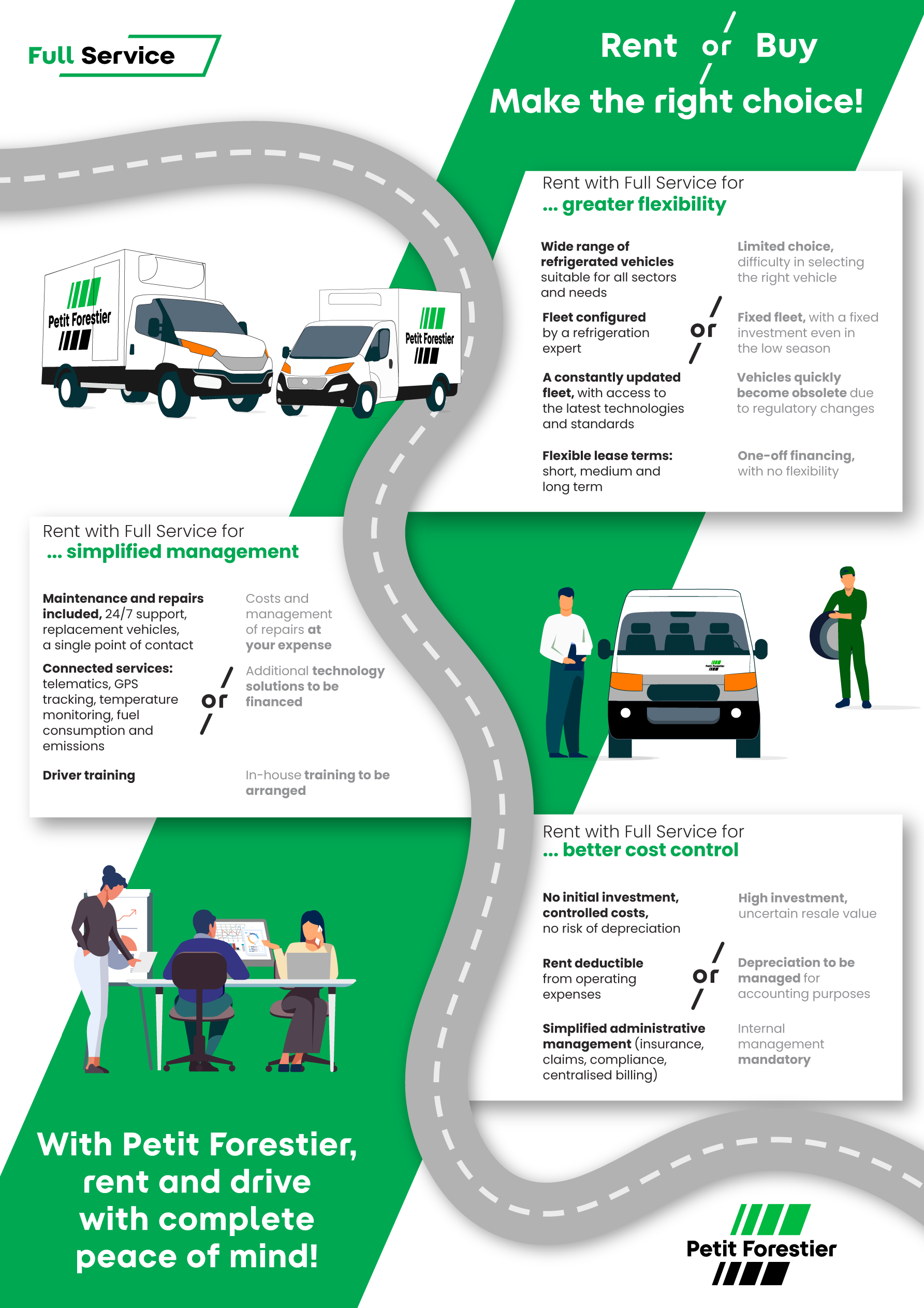
Operational flexibility: adapting in real time to fluctuations in business
One of the main drawbacks of buying is the inflexibility of a fixed fleet. A heavy capital investment ties up valuable resources, even during the off-season or during unexpected downturns in business. Conversely, opting to rent a refrigerated light commercial vehicle or a refrigerated heavy goods vehicle offers the agility needed to optimise daily operations.
Renting therefore allows you to adjust the composition and size of your fleet to suit your actual needs. Whether it’s:
- absorbing seasonal production peaks,
- to bolster your fleet for specific events,
- replacing a vehicle that has been damaged or is out of service,
- launching a new delivery service without taking any financial risk, etc.
Packages of varying durations (short, medium or long term) offer perfect flexibility. This gives businesses access to a constantly updated fleet featuring the latest refrigeration technology and compliant with environmental standards, whilst avoiding the pitfall of regulatory obsolescence.
Controlled capital allocation and a budget with no surprises
From an accounting and financial perspective, purchasing a refrigerated van or commercial vehicle involves a particularly high initial cash outlay, coupled with significant uncertainty regarding its resale value on the second-hand market.
The strategic choice of rental therefore eliminates the need to tie up capital and allows you to allocate it to your core business. All expenses related to the use of your equipment are consolidated into a single monthly rental payment, known in advance for better financial management. To delve deeper into the financial analysis of your assets and measure the direct impact of these models on your cash flow, you can consult our guide comparing renting and purchasing a refrigerated solution.
Finally, the accounting treatment of rental is also a significant advantage: depending on the local regulations in force (particularly for rental agreements), the lease payment can be directly recognised as an operating expense, which preserves your financing capacity and simplifies the clarity of your balance sheet. Please note, however: these accounting and tax rules vary by region and applicable standards (such as IFRS or US GAAP). It is essential to verify these terms and conditions prior to any international deployment.
Simplified technical and administrative management so you can focus on your core business
The technical maintenance of a refrigeration unit, monitoring temperature traceability and managing regulatory inspections place significant burdens on businesses. By choosing to purchase, operational responsibility, administrative procedures and the unforeseen costs of repairs fall entirely on your in-house teams.
Conversely, outsourcing the management of your refrigerated fleet allows you to delegate all this administrative burden to an expert. The Full Service rental contract provides you with a single point of contact, as well as comprehensive maintenance of the vehicle and refrigeration unit, 24/7 technical support, and the rapid provision of a replacement vehicle in the event of a breakdown or immobilisation.
As a result, your transport of goods and perishable foodstuffs is secured at every stage, guaranteeing business continuity and a significant reduction in disputes related to a break in the cold chain.
Expertise and a local network with no borders
Refrigerated logistics does not stop at regional or national borders. To support companies’ expansion across Europe or internationally, being able to rely on a global partner is a highly strategic advantage.
Thanks to a multi-sector presence, professionals benefit from personalised support to design the fleet best suited to their business requirements. Next-generation connected tools, such as the integrated Smart Connect telematics system, now make it possible to monitor fleet performance, better manage drivers and their performance, audit fuel consumption and monitor the temperature of the cargo compartment in real time. Please note: the features and availability of these connected services are tailored to the specific regulatory and technical requirements of each country’s offering.
Good to know: Petit Forestier’s extensive network of branches guarantees you responsive, tailor-made support.
Refrigerated vehicles available for hire
As a reminder, a fleet must meet the needs of professionals by adapting transport solutions to volume, payload, load length and your delivery routes. Fleets are generally divided into three main types of equipment:
| Type of vehicle | Main use | Technical specifications |
| Light commercial vehicles (vans and pick-ups) | Local urban delivery | Models available with an ergonomic cab (2 or 3 seats), with manual or automatic gearbox. |
| Heavy goods vehicles | Regional distribution | Every detail of the bodywork is designed to maximise load capacity in line with loading bay height restrictions. |
| Refrigerated trailers | Large-scale logistics and road haulage | The trailer or semi-trailer offers maximum capacity to ensure the safe transport of large volumes of goods. |
A solution tailored to the demands of modern logistics
Beyond the financial aspects, the success of a temperature-controlled transport strategy depends on the perfect match between the rolling stock, the nature of the goods and your operational model. Unlike the second-hand market, where choices are often limited, renting allows you to avoid the initial cost of buying a new fleet whilst gaining access to tailor-made solutions for the protection of your products.
Depending on your distribution requirements, the choice of engine will be between standard diesel, essential for long journeys, or an alternative energy source such as electric for urban deliveries. This technical flexibility ensures the refrigeration capacity needed to strictly maintain the temperature, regardless of the load volume. Finally, having a vehicle perfectly suited to your logistics flows allows you to cope with ease with the constraints of urban traffic or major road networks, thereby ensuring the complete continuity of your business.
As you will have gathered, far from being a mere financing option, renting has established itself as an essential lever for performance and peace of mind for refrigeration professionals. It allows you to avoid the risks associated with equipment depreciation, eliminate hidden maintenance costs, and adapt instantly to changing regulations and your operational needs.